See what's coming.
Deft is the insight and foresight engine for today's healthcare executive helping carriers and systems anticipate behavior, stress-test strategies, and move confidently in markets defined by margin pressure and disruption.

Deft is the insight and foresight engine for today's healthcare executive helping carriers and systems anticipate behavior, stress-test strategies, and move confidently in markets defined by margin pressure and disruption.
To improve your consumers’ healthcare experience, you must first gather the data and insights that can drive better decision making. Our market research services give health systems and providers a clearer view of their healthcare landscape, allowing them to become more efficient, more effective, and deliver better care.

When you partner with Deft Research, you can rest assured that we secure all your sensitive information at the highest level while also meeting industry compliance standards for effective risk mitigation. Learn about what HITRUST certification means for you.
Select a quarter to explore our recent and upcoming syndicated studies and custom research solutions in the senior and commercial markets.

Senior Market
Higher utilization and MLR pressures demand that Medicare stakeholders better understand the health needs of their beneficiaries than ever before. This first-of-its-kind syndicated study illuminates the health segments within our clients’ senior population so that organizations can best serve their unique needs.

Senior Market
Higher utilization and MLR pressures demand that Medicare stakeholders better understand the health needs of their beneficiaries than ever before. This first-of-its-kind syndicated study illuminates the health segments within our clients’ senior population so that organizations can best serve their unique needs.

Senior Market
In this study, you’ll discover how various health-based segments of seniors approached the AEP in terms of appealing features and valued services. You’ll also learn which paths MedSupp and MA seniors took from the start of AEP to their final decision — and which influences mattered as they progressed from shopper to switcher.

Senior Market
In 2025, we learned just how influential the Part D component can be for MAPD consumers as prescription habits shifted under the protection of a $2,000 MOOP. With negotiated drugs in play for 2026, how are seniors likely to respond to cost increases and design changes (up-tiering, copay to coinsurance, etc.) as carriers grapple with high drug spend against the rise of the $0 premium Part D plan? In this study, we’ll glean how the tiered placement of specific, common medications influences MAPD and Part D consumerism.

Commercial Market
With greater stabilization on the horizon, our Individual and Family Plan Shopping and Switching Study can help you understand the decisions consumers and their agents made regarding coverage selection despite impacts to premium. The study explores how members fared with changes experienced in OEP, how they shopped for coverage, and the degree to which they turned to agents during this time of significant change.

Senior Market
Our 2026 study features sections on the product nuances that Duals find most important in the post-VBID era, how the potential reintroduction of drug copays has changed what matters in design, how nontraditional marketing channels may connect better with Duals, and what sales-minded professionals must focus on to align their approach with the needs of these unique beneficiaries.

Commercial Market
For this study, we developed two conjoint models from two separate surveys to help you with your on-exchange or off-exchange design needs, or both. Plus, purchasers receive access to an online product simulation tool that allows them to test a myriad of plan design changes so they can size their designs to match their target consumers’ sensibilities.

Senior Market
The Medicare Member Onboarding and Management Study is a guidebook that shows carriers how to orchestrate new plan-year updates with longstanding members, as well as how to onboard new members from the AEP through the first few weeks of January.

Commercial Market
This new report examines two of the three stakeholders who will ultimately decide the trajectory of ICHRA in the near term: the employers who are looking to untangle health insurance from employment and the brokers who will (or will not) facilitate that transition.

Senior Market
With nearly four million consumers turning 65 in 2026 — and cost pressures mandating that carriers extend member LTV — carriers, ad agencies, and consultants need to understand how to curate products and experiences to improve immediate acquisition while lessening the early year retention risk now plaguing the industry. Our 2026 Medicare Age-In Study can help them figure it out.

Senior Market
The 2026 SNP (C-SNP and D-SNP) Experience Study is a powerful blueprint for carriers and agencies to follow, helping them to best serve those who are dually eligible, as well as those with specific demanding health conditions.

Commercial Market
Our 2026 ICHRA Study Part II: Employees report chronicles how employees managed through cost change, how that impacted them, and how they compare to employees in traditional group coverage who may not have seen quite as high premium increases.

Senior Market
Our AEP Gut Check Study acts as a “Pre-AEP” report to ensure you’re pointed in the right direction before rolling out your strategy. We assess seniors’ pain points, service failures, and plan experiences so carriers can make last-minute adjustments to their marketing and design efforts, even after benchmarks are released.
Senior Market
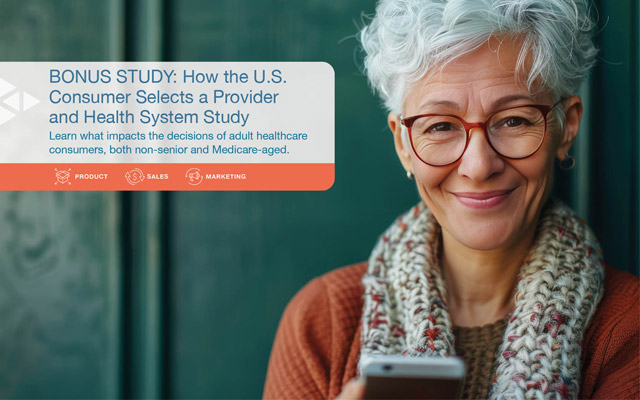
In this first-of-its-kind study, we look across the broad U.S. healthcare consumer landscape to learn how to improve the experiences of consumers seeking new primary care providers, the value that payers and health systems bring to healthcare consumers for in-network status, how consumers’ relationships with specific providers impact their loyalty to (and preference for) their associated health systems and so much more.

Senior Market
In this study, we review how seniors feel about shopping for Medicare plans online, what is useful, and what is not. It also explores the areas where seniors are beginning to accept AI, how carriers must couch its usage within the plan, and profiles the elements of portal technology that more online-savvy consumers demand.

Senior Market
In this 2026 study, we help stakeholders understand the specific touchpoints that set up seniors to renew coverage—and those that motivate them to disenroll. We also examine how various experiences are associated with higher and lower CAHPS scores, as well as advise carriers and agencies how to better engineer member communications and customer service for higher scores in future years.

Commercial Market
Greater competition in the ACA market means consumers are no longer confined to just a few participating carriers. In fact, the average state has at least five carriers now. To remain competitive, all on-exchange participants will need to focus on retention more than ever. This study identifies the experiences that either inflate or depress loyalty, so carriers can know how to better hold onto ACA members.